
A car that will not start does not automatically need a new starter. A weak battery, poor cable connection, charging problem, ignition switch, relay, immobilizer, or engine fault can produce similar symptoms. The fastest responsible repair begins by identifying what happens when the key turns or the start button is pressed. Jammin J Auto in Overland, Missouri, provides auto diagnostics and engine repair for drivers in the St. Louis area. This guide explains the starter’s job, the signs that point toward it, and what a shop should check before recommending replacement.
What does the starter motor do?
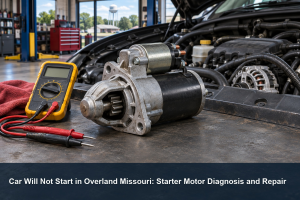
The starter uses electrical power from the battery to turn the engine until combustion can sustain itself. The circuit includes the battery, cables, control switch, relays or modules, solenoid, and starter motor. When a driver hears only a click, the sound does not identify which part failed. A click can mean the solenoid is trying to work while current cannot reach the motor; it can also occur when the battery lacks the power to crank. The diagnosis must follow the circuit, not the most familiar component name.
What happens when the key is turned?
A no-start description should begin with the exact symptom. Does the engine crank at normal speed but fail to fire? Does it crank slowly? Is there one click, a rapid series of clicks, silence, or a grinding sound? Does the dashboard dim? These observations narrow the testing path. A normal-speed crank usually means the starter is turning the engine and attention should move to fuel, spark, sensor, or other engine-control issues. A no-crank condition focuses attention on battery power and the starting circuit.
Why a weak battery resembles a bad starter
A discharged or aging battery may light the dash yet fail under the much greater load of starting. Cold Missouri mornings can expose a marginal battery. A technician should measure battery state and performance under load, then check terminals and cables for corrosion or loose connections. Jump-starting may get the vehicle moving but does not prove the battery alone is the cause. If the alternator is not restoring charge, the same problem can return. Replacing the starter without checking the battery and charging system risks paying for a part that was never faulty.
Single click, rapid clicks, and silence
One solid click can arise from a starter solenoid, low voltage, a poor high-current connection, or a mechanical issue. Rapid clicks often accompany voltage collapse as the circuit repeatedly engages and releases. Silence can indicate a control-side issue, such as a relay, switch, safety interlock, or security system, though it may also be a dead battery. These are clues, not conclusive tests. The technician will interpret them with battery measurements, voltage-drop testing, circuit commands, and the vehicle’s wiring information.
Intermittent starting deserves an early inspection
A starter that works on one attempt and fails on another can leave a driver stranded without a long warning period. The cause might be a worn motor, heat-sensitive connection, failing relay, or problem in the control circuit. Write down whether the failure appears after a long drive, after sitting overnight, or only with a particular key or start-button sequence. Do not keep driving on the assumption that a second try will always work. Intermittent faults are easier to trace when the shop has the circumstances and can reproduce the symptom.
Grinding noises and delayed disengagement
A harsh grinding noise during cranking can involve the starter drive gear, flywheel teeth, or alignment. A starter that continues to engage after the engine starts needs prompt attention. Stop repeated attempts if a new grinding sound occurs; repeated cranking could add damage. The correct repair depends on inspecting the interacting parts, not replacing the starter by sound alone. Tell the shop when the noise occurs, how long it lasts, and whether the engine eventually starts normally. A brief recording may help if the symptom is intermittent.
How a shop diagnoses a no-crank vehicle
A diagnostic sequence typically verifies battery condition, terminals, ground and positive cables, command to the starter, voltage under load, and starter response. The technician may check for relevant fault codes or immobilizer warnings and consult wiring diagrams for the exact vehicle. Voltage-drop tests can uncover resistance in a cable that looks acceptable from outside. If the starter receives proper power and command yet does not crank, replacement becomes more plausible. If voltage or command is missing, the repair belongs elsewhere in the circuit.
When a tow is safer than another attempt
A vehicle that will not crank reliably should not be taken on a trip where a failure could leave the driver in an unsafe place. If there is smoke, a burning smell, unusual cable heat, or grinding, stop attempts and seek assistance. If the car stalls in traffic, will not shift or steer normally, or is on a busy roadside, prioritize personal safety and roadside service. A tow can cost less than damage caused by repeated forced starting. Give the repair shop the symptom history and any warning lights seen before the failure.
What starter replacement may include
When testing confirms the starter is faulty, the job may involve removing adjacent components to access it, installing a suitable part, checking connections, and verifying that the vehicle starts repeatedly. Access varies greatly by model, which is why labor costs differ. Ask whether the estimate includes diagnostic work, the replacement unit, related hardware, and any necessary cable or terminal repair. A good completion check should confirm cranking performance and charging behavior, because a repaired starter will not solve an ongoing power problem.
What Overland drivers can do before calling
Move to a safe place and record the symptom without repeated attempts. Check whether lights are bright, whether a security indicator flashes, and whether the transmission is fully in Park or Neutral as appropriate. Do not crawl under a vehicle to strike a starter or bypass electrical controls. If a jump is attempted, follow the vehicle manual and safe jump-start procedures; modern vehicles can have specific requirements. Tell Jammin J Auto the year, make, model, location, whether the engine cranks, and any recent battery or alternator work.
How Jammin J Auto fits the repair decision
Jammin J Auto lists diagnostic and engine repair services at its Overland shop, 10188 Page Avenue. A no-start visit should begin with the actual symptom and a test plan. The shop can discuss whether the issue is in the battery, charging system, starter circuit, or another system, then provide a repair recommendation and estimate. Parts, access, and scheduling depend on the vehicle. Calling 314-423-3876 with the symptom details helps the team advise on the next practical step and whether the car should be towed.
Avoid replacing parts by guesswork
No-start problems invite a chain of unnecessary purchases: battery, then starter, then alternator. A measured diagnosis prevents that sequence. Request the findings that support the recommended repair and ask whether the part failure was confirmed under load. If a battery is replaced, ask why it failed and whether charging output was checked. If the starter is replaced, ask what was verified after installation. The goal is a vehicle that starts reliably in daily use, not a one-time success in the shop parking lot.
Why the check-engine light may be unrelated
A check-engine light can appear at the same time as a starting problem, but the code it stores may not identify the starter or even the immediate no-crank cause. Some faults can prevent a start; others may have been present for weeks. A technician should read codes in context with live voltage, cranking behavior, and the vehicle’s history. Tell the shop whether the light was on before the vehicle failed and whether any warning appeared immediately afterward. The presence or absence of a code does not replace circuit testing. This distinction helps avoid the common mistake of replacing a sensor because a scanner named it while the actual battery connection remains poor.
What a successful repair should prove
The repair is complete when the vehicle starts reliably and the tests explain why it previously failed. Ask the shop whether it checked battery condition, cable voltage drop, starter command, and charging output as relevant to the diagnosis. If the replaced component failed because of a loose connection or repeated low voltage, that related problem should be addressed. Keep the invoice and note the conditions under which the no-start occurred. If the symptom returns, those details help the technician identify whether the same fault has recurred or a different fault has appeared.
Define the goal
The immediate question is whether the engine is cranking and, if not, which part of the starting circuit fails under load. A precise symptom description makes the first call more useful. A sound plan begins with a specific decision. State the problem in ordinary language, describe what has already happened, and identify the result you hope for. That gives the professional or service team a chance to distinguish a routine request from one that needs a different path. Keep expectations proportional to the information available: a web page can explain options, but the details of each situation still matter. The most efficient first conversation focuses on the next verifiable step rather than a promised outcome.
Gather the facts that matter
Bring recent battery invoices, maintenance history, warning-light notes, and a short record of when the no-start happens. A video with sound can help show an intermittent symptom. Good decisions rely on records that can be checked. Dates, symptoms, measurements, prior work, service agreements, financial records, or system reports can change the recommendation. Collect what is relevant and keep a simple timeline, including what changed and when. If an important fact is unknown, say so instead of guessing. A professional can then decide what to inspect, request, or test. This avoids a common problem: spending money on a solution chosen from a label alone before confirming the underlying cause.
Compare realistic options
Compare a battery, cable, relay, control, and starter diagnosis using measured voltage and command results rather than replacing the cheapest or most familiar part first. Comparisons are useful only when the choices address the same goal. Ask what each option includes, what it excludes, who performs the work, and which conditions would make it unsuitable. Consider the effect on time, convenience, future maintenance, and the ability to change course. A lower initial price or faster appointment may be sensible, but only if it solves the actual problem. Written scope and clear questions make tradeoffs visible. If two recommendations conflict, ask which facts or assumptions are different before deciding that one is wrong.
Follow the right order
Secure the vehicle, record the symptom, arrange a tow if needed, test the battery and circuit, review an estimate, then verify repeated starts after repair. The order of steps matters. Some work requires diagnosis or review before a quote; some decisions should be documented before payment or treatment begins. Ask what happens first, what information is needed at each stage, and who is responsible for the next action. A short written plan can prevent a stalled handoff. It should distinguish a confirmed step from an estimate and identify when new information would change the plan. This is especially helpful when several people or organizations are involved and each assumes someone else will follow up.
Plan the timing
Intermittent starting can worsen without warning. Plan an inspection before travel or commuting needs make a breakdown more costly. Timing depends on availability, urgency, complexity, and outside requirements. Ask which dates are estimates, which are deadlines, and what can cause delay. Plan for the time needed to gather documents, obtain parts or approvals, schedule an appointment, and review a result. A rushed decision may be necessary in an urgent situation, but routine work benefits from a realistic sequence. If a date matters for a move, event, treatment, court appearance, or business launch, state it early. Confirm the next milestone in writing and revisit it if circumstances change.
Understand the full cost
Ask what diagnostic work is included and whether the estimate covers the part, labor, electrical connections, and post-repair verification. Ask for the scope behind any price. A fee or estimate may cover only an initial visit, a defined repair, a single service, or part of a larger project. Clarify whether tests, materials, revisions, travel, follow-up, or third-party charges are separate. Value also includes the quality of the diagnosis, communication, documentation, and the durability of the result. No responsible provider can promise the cheapest route in every case. A useful conversation explains what is known now, what could change the cost, and when a revised estimate would be discussed.
Avoid common mistakes
Repeatedly forcing a grinding starter, jumping a vehicle incorrectly, or driving to an unsafe location can add harm. Stop and seek assistance when the symptom is severe. Most preventable problems begin with an assumption left untested. Do not treat a general description as proof that it fits the particular situation. Do not omit facts because they seem embarrassing, minor, or unrelated; they may explain a symptom, limit an option, or change a deadline. Ask about warning signs that require prompt attention and about conditions that would justify a second opinion. Keep copies of instructions and agreements. If the proposed next step is unclear, ask the team to restate it in plain language before proceeding.
Check the result and follow up
After repair, confirm reliable cranking across several starts and ask the shop what underlying battery or charging issue, if any, was also found. The immediate step is only part of the outcome. Confirm what result should be checked and when. Save the relevant records, note any new question, and contact the responsible team if the expected step does not occur. Review whether the outcome actually addressed the original need. That feedback can guide a later adjustment and helps the provider improve its process. For ongoing needs, choose a practical review interval instead of waiting until an avoidable problem becomes urgent.
Jammin J Auto lists its diagnostic and engine repair services and Overland contact details.
Frequently Asked Questions
Is one click always a bad starter?
No. One click can also result from low voltage or a poor cable connection. Testing is needed.
Why do I hear rapid clicking?
Rapid clicking often happens when voltage drops during an attempted start, but the battery and circuit need testing.
What if the engine cranks but does not start?
That is usually a different diagnostic path involving fuel, spark, sensors, or engine controls.
Can a bad alternator cause a no-start?
Yes. A charging fault may leave the battery too weak to crank after the vehicle is parked.
Can cold weather expose starter problems?
Cold weather can make a marginal battery or connection more apparent; testing should identify the actual cause.
Should I replace the battery first?
Only if testing shows it is faulty or unable to hold charge. Check related charging and connection issues.
Is an intermittent no-start worth checking?
Yes. Record when it happens and arrange diagnosis before it leaves you stranded.
What does starter diagnosis cost?
The charge depends on the shop and work needed. Ask for the diagnostic fee and estimate before repairs.
How long does starter replacement take?
Access and part availability vary by vehicle, so ask for an estimate specific to yours.
Can I drive with a failing starter?
The car may run after starting, but the next start may fail. Plan repair promptly.
When should I stop trying to start the car?
Stop if there is smoke, burning smell, unusual heat, grinding, or repeated unsuccessful attempts.
Where is Jammin J Auto?
The shop is at 10188 Page Avenue in Overland, Missouri; call 314-423-3876 for current service availability.